
A classic memory card game hides pairs face down and reveals two cards per move. “Tile matching” often describes visible match-3 boards or 3D puzzles where you collect identical tiles. Memory Matching is the classic hidden-pair game.
| Game type | What you see | Main action | Usual goal |
|---|---|---|---|
| Memory cards / concentration | Mostly face-down cards | Reveal two and remember positions | Find every identical pair |
| Match-3 | Visible grid of pieces | Swap or connect pieces | Create lines/groups of three or more |
| 3D tile match | Layered visible objects | Select matching tiles into a tray | Clear the layout without filling the tray |
| Picture-pair matching | Usually visible or briefly hidden items | Connect related images | Complete semantic or identical pairs |
What defines a memory card game?
The defining information is hidden. You reveal a card, observe its symbol, and learn its location. A second reveal either completes a pair or adds another location to remember. The board gradually changes from unknown to known.
The game is also called Memory, Concentration, Pairs, or Matching Pairs. Physical versions use cards; digital versions may look like cards or tiles, but the face-down information structure is what matters.
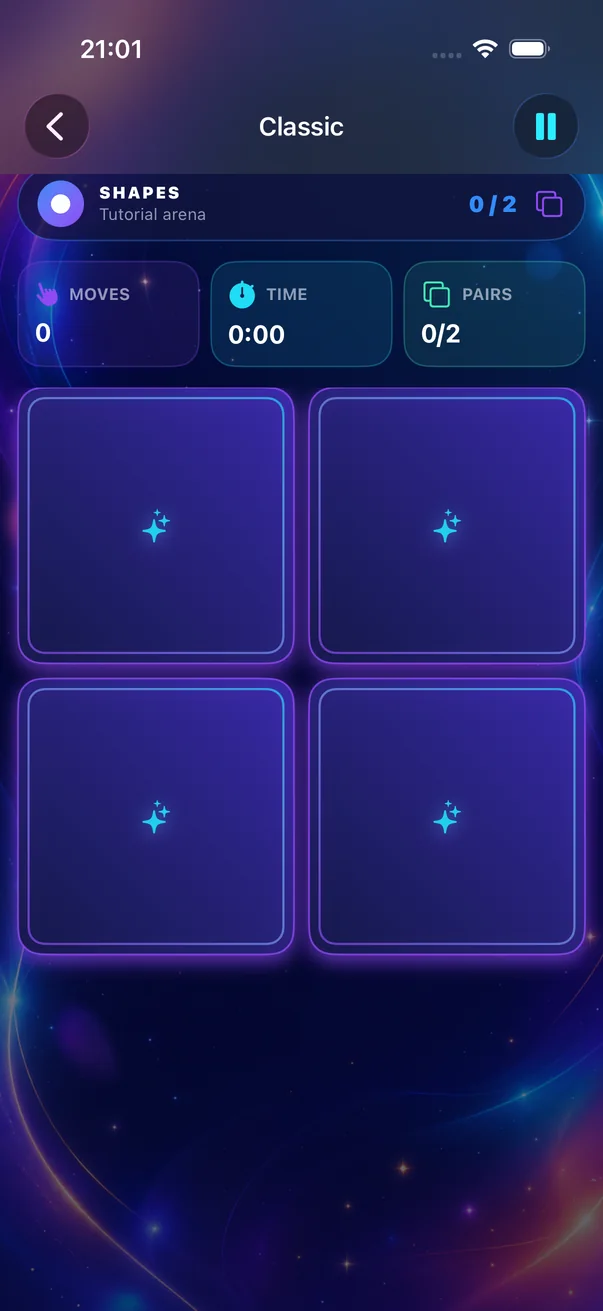
What “tile matching game” usually means now
The phrase can still describe any game with tile-shaped pieces, including a digital memory board. In current app and web results, however, “tile match” commonly points to two other genres.
Match-3
The board is visible. You swap, drag, or connect pieces to form groups—often three or more identical colours or symbols. Planning comes from arrangement, cascades, obstacles, and future moves rather than remembering hidden locations.
3D tile clearing
A layered pile of visible objects fills the screen. You select identical pieces, often in groups of three, and manage a limited tray while uncovering blocked objects underneath.
Why the difference matters when searching
If you want the reveal-two game, search for “memory matching game,” “memory card game,” “matching pairs,” or “concentration game.” A broad search for “tile matching game” may return visible match-3 or 3D tile-clearing puzzles instead.
Quick test: If the game begins with every picture hidden and each turn reveals two positions, it is a classic memory matching game. If all pieces are visible and you arrange or collect them, it belongs to a different matching genre.
How scoring differs
Classic memory games naturally track moves and time because each two-card attempt reveals information. Accuracy can compare matches with total attempts. Match-3 and tile-clearing games are more likely to score combinations, cascades, level objectives, tray management, or remaining moves.
Memory Matching reports time, moves, accuracy, and a size-weighted score. Its Time Attack changes the deadline, but not the core reveal-two rule.
Which should you choose?
- Choose memory cards when you want a hidden-information game built on recall and location.
- Choose match-3 when you want visible board planning and combinations.
- Choose 3D tile matching when you enjoy searching layered scenes and managing a collection tray.
None is inherently better. The useful distinction is whether the game shown in search results matches the mechanic you expected.
If classic pairs are what you want, read the complete rules or compare Memory Matching’s four board sizes.