
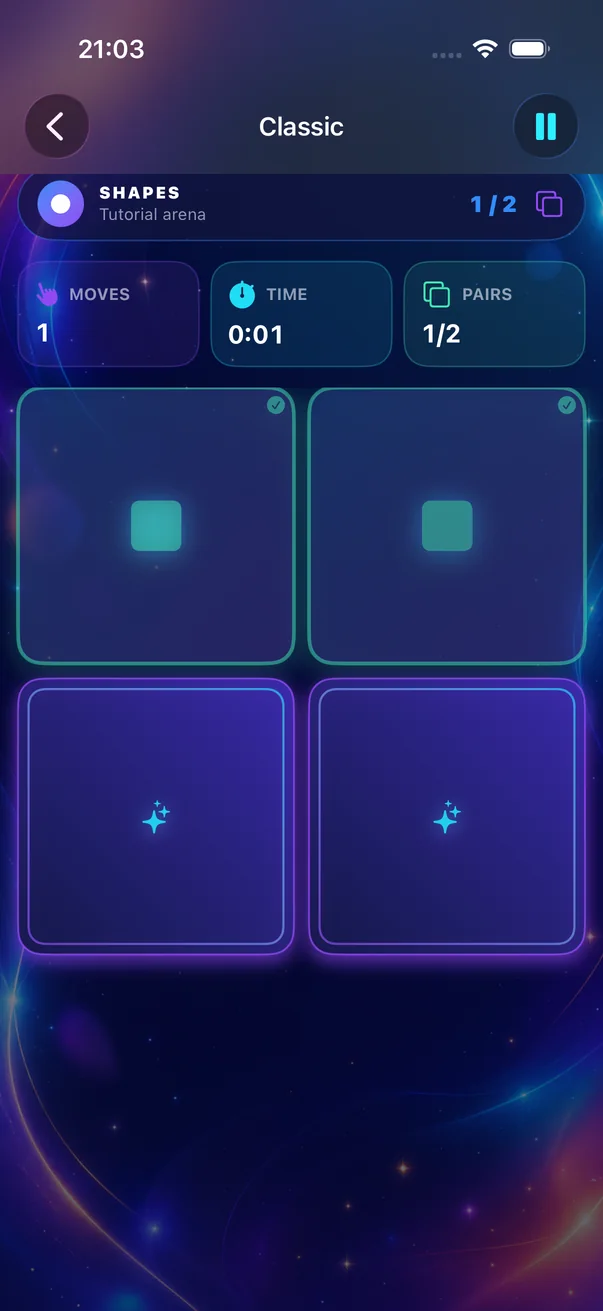
A memory matching game starts with pairs of identical symbols shuffled face down. On each move, you reveal two cards. A pair stays visible; a mismatch turns back over. Complete the game by finding every pair.
The rules in six steps
- Start with a shuffled board. Each symbol appears exactly twice, and every card begins face down.
- Reveal a first card. Notice both the symbol and its position in the grid.
- Reveal a second card. Choose a card you have not seen, or return to the remembered location of its partner.
- Resolve the turn. Matching symbols stay revealed. If they differ, both cards turn face down after a short pause.
- Keep building your mental map. Even a mismatch gives you two useful locations for later turns.
- Find every pair. When no face-down cards remain, the board is complete.
What counts as a move?
In Memory Matching, one move is the attempt formed by revealing two available cards. A successful move finds a pair. An unsuccessful move is still valuable because it reveals two positions you can use later.
Accuracy is the share of your moves that became matches. A perfect board uses exactly as many moves as there are pairs: six moves on Easy, eight on Medium, ten on Hard, and eighteen on Expert.
Example turn: You reveal a star in the top-left corner, then a circle near the centre. They turn back over. Later, when another circle appears, you can return to the remembered centre card and complete that pair.
How Memory Matching changes the basic rules
Classic
There is no failure condition. Find every pair and use the result screen to compare time, moves, accuracy, and score with your previous boards.
Time Attack
The matching rules stay the same, but the board must be cleared before the size-specific timer reaches zero.
Daily Challenge
The daily rule can be a standard board, a time limit, a move limit, a two-second preview, or a similar-symbol challenge. The rule is shown before you begin.
Zen and Custom
Premium adds a calm Zen option and a Custom Quest screen for choosing a standard board, available theme, and custom rules.
Moves, time, accuracy, and score
The result screen reports four different views of the same round:
- Time shows how long the completed attempt took.
- Moves counts two-card attempts.
- Accuracy compares successful matches with total moves.
- Score combines board size, accuracy, extra moves, and time using the game’s scoring rules.
There is no single “correct” target. A relaxed player can simply clear the board; a competitive player can pursue fewer moves, a faster time, or an eligible Game Center score.
Three beginner tips
- Work across the grid in a consistent direction instead of tapping randomly.
- Name each symbol and location in a short phrase: “star, top left” is easier to retrieve than a vague impression.
- When you reveal a symbol you have seen before, pause and retrieve its partner’s location before tapping again.
For a deeper method, continue with the seven practical memory matching strategies, or compare the four board sizes.