
To get better at memory matching, replace random tapping with a repeatable system. Scan in one direction, encode each card with a location, and use known information before revealing something new.
1. Scan the board in a fixed order
Choose a route before your first move: left to right across each row, top to bottom by column, or clockwise from one corner. A stable route gives each new card a place in a sequence. Random exploration creates disconnected impressions that are harder to retrieve.
You do not have to finish the entire route. As soon as a revealed card matches something you already know, complete that pair. Then return to your scan.
2. Encode the symbol and the location together
“Moon” is incomplete information. “Moon, second row, far right” gives you a retrieval path. Use whatever coordinates feel natural: row and column, corners and edges, or nearby landmarks such as “below the star.”
Try this: quietly name both details on every reveal—“leaf, bottom left.” The wording should be short enough to repeat without slowing the game.
3. Treat mismatches as useful information
A mismatch is not a wasted turn. It adds two known locations to the board. The real loss comes from revealing the same unmatched card repeatedly without using what you learned.
After a mismatch, briefly rehearse both positions before the cards turn back over. If you know that either symbol has a partner elsewhere, plan that next move immediately.
4. Retrieve before you tap
When the first card of a turn shows a familiar symbol, pause. Ask: “Where did I see its partner?” Retrieve the location before your finger moves. This small pause reduces reflexive guesses and makes your existing board knowledge do the work.
5. Clear certain pairs before exploring
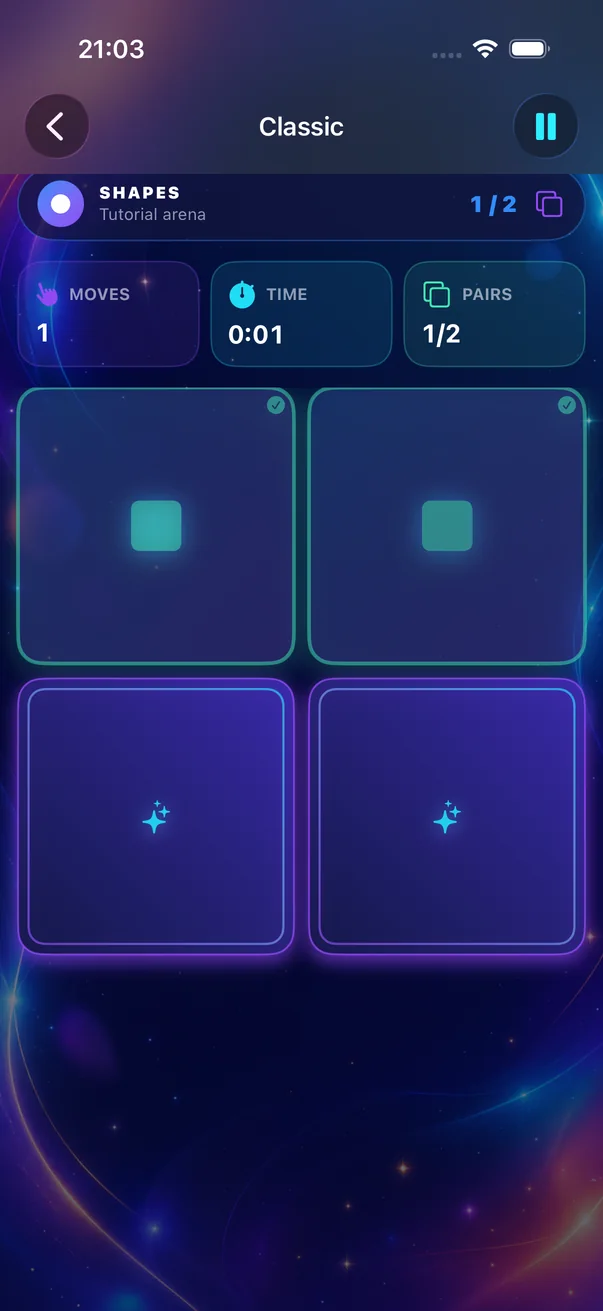
If you know both locations of a pair, take it. Clearing confirmed pairs reduces visual clutter and prevents known locations from competing with new ones. It also shrinks the number of possible choices on later turns.
The exception is a timed situation where another route is obviously faster, but for most boards, converting certainty into a match is the cleanest play.
6. Use the edges as anchors
Corners and edges are easier to describe than cards in a crowded centre. Learn the outer ring first when a large grid feels overwhelming. Then divide the centre into smaller zones—top-centre, middle-centre, and bottom-centre, for example.
On Expert’s 6 × 6 board, think in 2 × 3 or 3 × 3 regions rather than one field of 36 individual cards.
7. Choose a board that produces useful mistakes
A board is productive when you can remember some locations but still have to work. If nearly every turn feels random, move down a size and practise the same system. If the board clears without any uncertain choice, move up.
Memory Matching offers four standard sizes: Easy has 6 pairs, Medium 8, Hard 10, and Expert 18. The difficulty guide explains when each size is useful.
A simple turn-by-turn routine
- Before the first flip, know where your scan will continue.
- Reveal a card and name its symbol plus location.
- If you know the partner, retrieve its location and match it.
- If you do not, reveal the next unexplored card in your route.
- After a mismatch, rehearse both locations once.
- Clear any pair that has become certain.
What these strategies can—and cannot—promise
These methods can make your decisions more systematic inside a matching-pairs game. They are not medical advice and do not guarantee broader memory improvement, treatment, or protection against cognitive decline. Play because the process is enjoyable, and judge progress using the game’s own time, moves, accuracy, and score.
New to the rules? Read how to play Memory Matching before practising the routine.