
A good memory game for adults does not need complicated rules. Look for polished presentation, adjustable challenge, short complete sessions, useful progress, honest benefit language, and monetisation that does not manipulate the player.
Start with the mechanic you actually want
“Memory game” is a broad label. Search results include matching pairs, sequence repetition, spatial recall, word tasks, and large brain-training collections. If you want the classic card game, the product should clearly show face-down cards that are revealed two at a time.
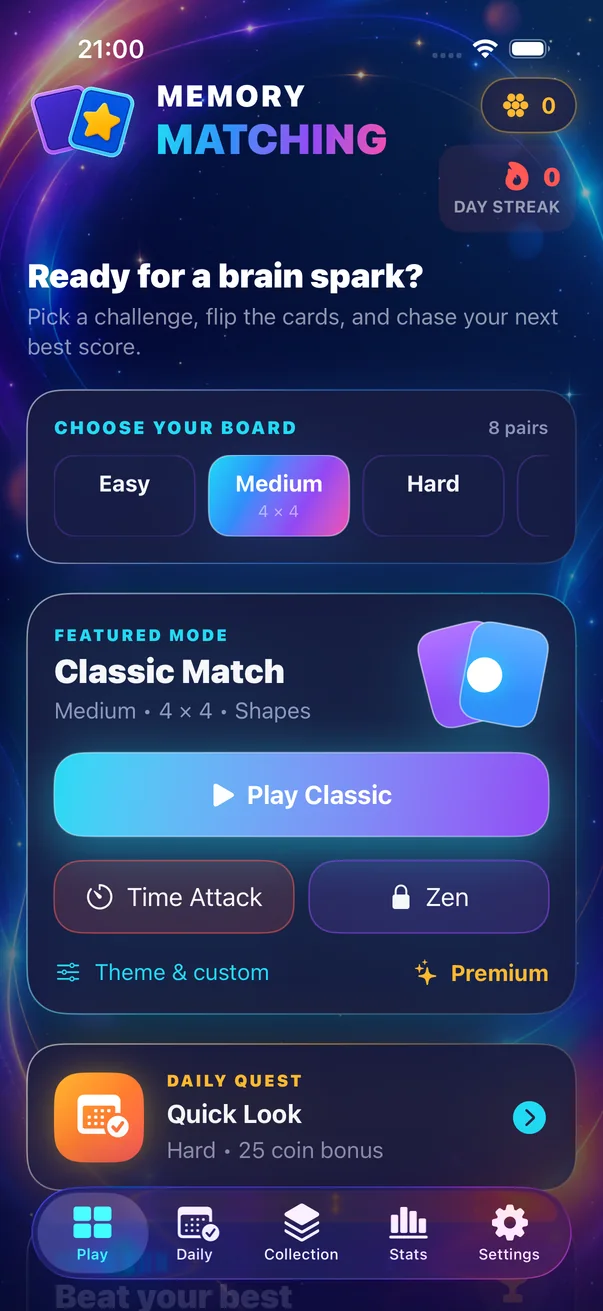
Memory Matching stays focused on that familiar loop. It adds modes, boards, themes, and progression without replacing the central matching-pairs rule.
Seven things worth checking
1. A clear first minute
You should know what to tap and what success looks like almost immediately. An interactive tutorial is more useful than a dense instruction screen because it lets you learn through one tiny board.
2. Difficulty you control
One board size cannot serve every mood. A six-pair board works for a quick break; an eighteen-pair grid creates a longer, denser challenge. Look for visible pair counts rather than vague “easy” and “hard” labels alone.
3. Calm and competitive options
Sometimes you want to clear a board without pressure. At other times, a clock, move target, daily rule, or personal best adds energy. A flexible game should let the same mechanic support both.
4. Results you can understand
Time and moves answer different questions. Accuracy shows how often a two-card attempt produced a pair, while a score can combine speed, efficiency, and board size. Useful results should help you set your own next target, not manufacture a clinical judgement.
5. Honest claims
A matching game uses attention, recall, concentration, and pattern recognition during play. That does not automatically prove medical benefit, guaranteed memory improvement, or protection against decline. Be cautious when entertainment copy turns into treatment language.
6. Privacy that matches the product
A simple casual game should explain whether it requires an account, stores progress locally, sends data to a backend, or uses third-party ads and platform services. “No account” is useful; “no data collection” is a much broader claim that may not be accurate when ads, purchases, or leaderboards are involved.
7. Monetisation you can predict
Check whether the game uses a subscription, permanent purchases, consumable energy, forced waits, or ads during play. Memory Matching has no subscription or lives. Its optional purchases are permanent; active boards are not interrupted by interstitial ads.
A practical checklist: Can you play offline? Can you start without an account? Are difficulty and modes visible? Are purchases permanent or recurring? Can ads interrupt a board? Does the product make claims it can support?
Why short sessions matter
A complete casual-game break has a beginning, middle, and end. Matching pairs works well because the board itself shows progress: hidden cards become known positions, then confirmed pairs, then a clear result. You can stop after one board without leaving a campaign or energy timer unfinished.
Daily Challenges can add continuity without demanding a long session. Memory Matching rotates between standard, timed, move-limited, preview, and similar-symbol rules, then records a streak and weekly progress locally.
Adult-friendly is not age-exclusive
Clean typography, controllable sound and haptics, a mature visual style, and flexible challenge can appeal to adults without labelling the product as “only for adults.” Memory Matching is a general-audience app. It is not a Kids Category product, a senior-care tool, or a medical programme.
A note about “brain training”
People often use “brain training” as a discovery phrase for puzzles. On this site, it describes the kind of attention and recall a matching board asks you to use—not a promise that playing will transfer to school, work, health, or everyday memory. The honest reason to play is that the game is clear, satisfying, and enjoyable.
Next, compare Easy through Expert board sizes or learn how to make fewer uncertain moves.